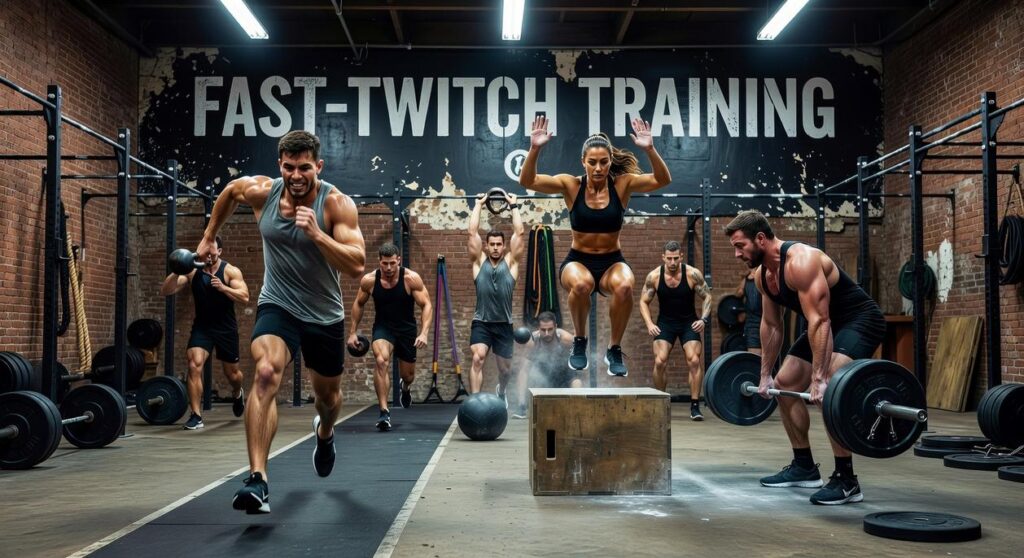
Most athletes train harder when progress stalls. The smarter move? Train according to how your muscles are actually built. Understanding fast twitch vs slow twitch fibers is the missing link between effort and results. Slow-twitch fibers drive endurance and sustained performance, while fast-twitch fibers power explosive speed and strength. If your workouts don’t align with your dominant fiber type—or the demands of your sport—you’ll keep hitting frustrating plateaus. This guide breaks down the science in clear, practical terms and gives you a simple framework to structure your training for endurance, power, or hybrid performance. By the end, you’ll know exactly how to train for maximum results.
The Two Engines Driving Your Movement: A Simple Breakdown
Every muscle in your body runs on a blend of fiber types—but your personal ratio is as unique as your fingerprint. Scientists have confirmed this through muscle biopsy studies showing wide variation in fiber distribution among individuals (Journal of Applied Physiology).
When people debate fast twitch vs slow twitch fibers, they’re really comparing two biological engines:
- Slow-Twitch (Type I): These are your endurance fibers. They rely on oxygen (aerobic metabolism), resist fatigue, and sustain low-force contractions for long periods. Think fuel-efficient sedan—steady, reliable, built for distance. Marathon runners often have up to 80% Type I fibers (Saltin et al., 1977).
- Fast-Twitch (Type II): These are your power fibers. They’re anaerobic, generate explosive force, and fatigue quickly. Picture a drag racer—blazing speed, short burst. Elite sprinters consistently show higher Type II percentages.
Genetics largely determine your ratio (Simoneau & Bouchard, 1989), predisposing you toward endurance or power activities (nature loads the gun; training pulls the trigger).
Mastering Endurance: How to Train Your Slow-Twitch (Type I) Fibers
Slow-twitch (Type I) fibers are your body’s endurance engine. They’re defined by high mitochondrial density (mitochondria are the “power plants” of cells), a rich capillary network, and efficient oxygen use. In plain terms: they resist fatigue and keep you moving for the long haul. Think marathon runners, long-distance cyclists, swimmers, and triathletes.
In the classic fast twitch vs slow twitch fibers debate, slow-twitch fibers win whenever duration matters more than raw power. But here’s where I’ll admit some uncertainty: genetics play a significant role in fiber distribution, and research is still evolving on how much you can truly shift that balance through training alone (studies suggest adaptations are more metabolic than structural).
Effective training leans toward high volume, low intensity:
- Resistance Training: 15–20+ reps with lighter weights and 30–60 seconds rest. The goal isn’t maximal force; it’s sustained tension.
- Cardiovascular Training: 45+ minutes of steady-state jogging or cycling at a consistent, conversational pace.
Some argue interval training is superior for all goals. They’re not wrong—it boosts VO₂ max efficiently. But for pure endurance capacity, steady work builds a deep aerobic base (boring, yes—but reliable). Pro tip: increase weekly volume gradually to avoid overuse injuries.
Unleashing Power: How to Train Your Fast-Twitch (Type II) Fibers
Type II muscle fibers are your body’s power generators. They contract quickly and forcefully, making them essential for explosive strength. There are two main types:
- Type IIa fibers: Fast and adaptable. They produce high force but resist fatigue better than IIx fibers.
- Type IIx fibers: The most powerful and fastest-contracting, but they fatigue quickly (think: all-out sprint, then gasping for air).
When comparing fast twitch vs slow twitch fibers, slow-twitch (Type I) fibers handle endurance, while Type II fibers dominate short, explosive efforts.
Sports That Rely on Type II Fibers
- Sprinting
- Olympic weightlifting
- Basketball jumps
- Track and field throwing events
If your goal is vertical leap, sprint speed, or raw power, these fibers matter.
Effective Training Methods
Focus on low-volume, high-intensity work with full recovery.
- Resistance Training: Heavy lifts (1–6 reps) with 2–5 minutes rest. Examples: squats, deadlifts, bench press.
- Power Training: Plyometrics (box jumps, clap push-ups), kettlebell swings, and HIIT intervals.
(Pro tip: Stop each set before your speed slows down—power drops when fatigue rises.)
Some believe sweating more equals better results, but intensity—not sweat—drives fiber recruitment. Learn why here: does sweating more mean a better workout.
Train explosively, recover fully, and your power output will climb.
The Hybrid Athlete: Optimizing for Sports That Demand Both
You’ve probably heard the claim: you can transform endurance fibers into explosive ones. Not quite. The debate around fast twitch vs slow twitch fibers often misses a key fact—Type I and Type II fibers are largely fixed at birth (McArdle et al., Exercise Physiology). You can’t turn one into the other.
But here’s where critics oversimplify. While you can’t swap fibers, you can train Type IIa fibers to behave more endurance-like or more power-driven. That adaptability is gold for hybrid athletes.
Consider sports like:
- Soccer (constant movement plus sudden sprints)
- Basketball (vertical jumps after long defensive sets)
- MMA (explosive exchanges between grueling rounds)
- CrossFit (strength under metabolic fatigue)
Some argue you should specialize—build strength or endurance. Yet periodization offers a smarter path. Cycle through focused blocks:
- Strength phase
- Endurance phase
This structured rotation builds both systems without sabotaging recovery (Issurin, 2010).
Pro tip: prioritize strength first in a training year—it’s harder to build and easier to maintain. (Yes, even if you love cardio.)
Building a fiber-focused plan doesn’t have to be complicated. Think in terms of your primary goal and match your training split accordingly. First, a quick clarification: slow twitch fibers support long, steady efforts, while fast twitch fibers generate explosive power. Now apply it.
Endurance Athlete (Runner):
• 70–80% low-intensity steady-state cardio and high-rep lifting.
• 20–30% light speed drills to stay sharp.
Power Athlete (Lifter):
• 70–80% heavy lifts, sprints, plyometrics.
• 20–30% aerobic base work for recovery.
Hybrid Athlete (Soccer Player):
• 2 strength/power days.
• 2–3 conditioning or sport sessions.
Keep it simple (no Rocky montages required).
You set out to train smarter, not just harder—and now you have the foundation to do exactly that. By understanding fast twitch vs slow twitch fibers, you can finally move beyond cookie-cutter programs and align your workouts with your body’s true demands.
No more wasted sessions. No more frustrating plateaus. When you match your training—endurance, power, or hybrid—to the fibers you need to develop, you increase performance while lowering your risk of burnout and injury.
Train With Purpose This Week
Look at your current training split. Does it truly reflect your goals? Make one targeted adjustment today and start training with intention—not guesswork.