
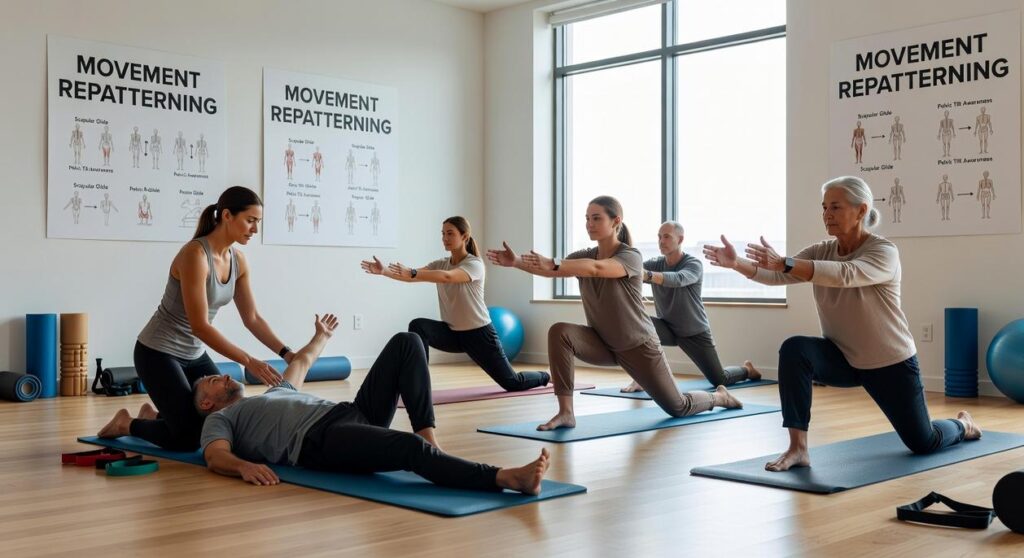
If you’re searching for a smarter way to train, move, and feel better in your body, you’re in the right place. This article breaks down the foundations of movement efficiency training—what it is, why it matters, and how it can transform the way you approach fitness, recovery, and everyday performance.
Many people work hard in the gym yet still deal with stiffness, plateaus, or recurring aches. The missing piece often isn’t effort—it’s efficiency. By understanding how your body is designed to move, you can build strength, stability, and endurance without wasting energy or increasing injury risk.
We’ve analyzed proven training principles, biomechanics research, and real-world performance strategies to bring you practical, science-backed guidance you can apply immediately. Whether you’re an athlete or simply want to move better in daily life, this guide will show you how to train with purpose—and get more results from every rep.
Feel the Shift in Every Rep
Your muscles burn, but the deeper issue is quieter—the subtle hitch in your squat, the stiff click in your shoulder. When movement patterns falter, progress feels like running through sand. You breathe harder, joints ache, and each rep sounds heavier than it should.
Strength isn’t the problem; coordination is. movement efficiency training teaches you to feel your feet grip, hear your breath steady, and sense power travel smoothly from heel to hand. Assess your form in a mirror, film a set, note where tension spikes.
- Reset, realign, and reclaim fluid power daily practice.
Beyond Muscles: What Are Movement Patterns?
Just as understanding movement efficiency principles can enhance your functional programming skills, grasping the concept of progressive overload can lead to sustainable gains in your physical training regimen – for more details, check out our Progressive Overload Explained for Sustainable Gains.
Movement patterns are the body’s built‑in “software.” They’re the neuromuscular blueprints (that’s the communication loop between your brain and muscles) that organize actions like squatting, pushing, pulling, and hinging. You’re not just contracting muscles—you’re running a coordinated program.
I learned this the hard way. Early on, I thought stronger legs meant a better squat. I loaded the bar, built the quads, and ignored the pattern. The result? Knee pain. My muscles were strong, but my movement was sloppy. It was like driving a car with misaligned wheels—technically powerful, but bleeding energy with every mile.
That’s the efficiency principle. Poor patterns leak force and demand compensation elsewhere. Optimized ones create seamless power and stability (everything just feels smoother).
Your central nervous system—the command center of the brain and spinal cord—coordinates these patterns. The good news? They’re adaptable. Through focused, repetitive practice, you can “rewire” them. That’s the backbone of movement efficiency training.
Here’s the domino effect: an unstable squat shifts load to the knees or lower back. Over time, strain shows up—even if the muscles test strong.
Strength without coordination is potential without control.
Pro tip: Film your lifts. What feels right and what looks right are often two different things.
The Foundational Five: A Self-Assessment Guide
Before you chase advanced workouts, master the BASICS. Human movement can be simplified into five core patterns: Squat, Hinge, Push, Pull, and Carry. These are not exercises—they’re patterns, meaning broad categories of movement your body uses daily (yes, even picking up groceries counts).
Think of them as your physical ABCs.
The Squat (Level Change)
A squat is simply lowering and raising your center of mass.
Test: Perform a slow bodyweight squat.
- Heels stay flat
- Knees track over toes
- Spine remains neutral (natural curve, not rounded)
If your heels pop up or knees cave inward, that signals mobility or stability gaps.
The Hinge (Hip Flexion/Extension)
A hinge means bending at the hips while keeping the spine stable.
Test: Hold a dowel along your spine—touching head, upper back, and tailbone. Bend forward.
All three points should stay connected. If the lower back rounds, you’re substituting spinal flexion for hip movement (a common fault).
Push & Pull (Upper Body Balance)
Push = pressing away. Pull = drawing toward.
Push-Up Test: Watch for hip sagging or shoulder shrugging.
Inverted Row Test: Body stays rigid; shoulders don’t creep toward ears.
Instability here often reflects weak core integration.
The Carry (Loaded Locomotion)
Carrying builds real-world strength.
Single-Arm Farmer’s Carry Test: Walk holding one weight.
- Stay upright
- Avoid leaning
- Keep steps controlled
If you tilt, your core isn’t resisting lateral force.
Mastering these patterns improves movement efficiency training outcomes and builds RESILIENT strength. Start simple. Move well. THEN add intensity.
A Three-Step Framework for Reprogramming Movement

If your squat, hinge, or press feels “off,” the solution usually isn’t more weight—it’s a better sequence. While there’s debate about how much mobility versus strength matters (and research isn’t always conclusive), this three-step model works well in practice.
-
Mobilize & Release
Before correcting a pattern, you need the range of motion to perform it. If your hips or ankles are restricted, your body will compensate (and not in a good way). Try the 90/90 hip stretch to improve rotational control and the wall ankle mobilization to increase dorsiflexion. Limited ankle mobility, for example, is strongly linked to altered squat mechanics (Macrum et al., 2012). Pro tip: breathe slowly during mobility drills—tension limits progress. -
Activate & Stabilize
Next, “wake up” the muscles meant to drive the movement. Glute bridges before squats help ensure the glutes—not the lower back—take over hip extension. Band pull-aparts before rows or deadlifts prime the upper back for better posture and shoulder stability. Some argue activation drills are overrated. That may be true for advanced lifters, but beginners often benefit from this neurological reminder. -
Groove the Pattern
Now practice with precision. Use goblet squats to refine squat depth and kettlebell deadlifts to pattern the hinge. Move slowly and deliberately. This is where movement efficiency training truly happens—quality before load.
If you want a deeper dive, explore breaking down the gerenaldo functional movement framework for expanded guidance. Master the pattern first; intensity can wait.
Integrating Optimized Movement into Daily Life
Movement doesn’t clock out when your workout ends. It’s a 24/7 practice. Yet most advice stops at sets and reps, ignoring how you bend, sit, and carry during the other 23 hours. That gap is where real transformation happens.
Some argue daily tweaks are overkill. But consider this: repeated poor mechanics while lifting laundry can strain your back as much as deadlifts (just without the applause).
• Use a precise hip hinge to pick items up.
• Lightly brace your core while sitting.
• Carry groceries tall, shoulders stacked over hips.
This is movement efficiency training applied to real life.
Your Next Move
You now possess a complete system to assess and upgrade your foundational patterns.
When progress stalls, most people add volume or intensity. That’s backwards.
The real edge comes from refining quality through movement efficiency training. This is where others stop at generic mobility drills.
Precision beats punishment.
Pick one weak pattern, apply the three-step reprogramming framework for two weeks, and track measurable changes in control, speed, and fatigue. Strength built on pattern integrity lasts. Efficiency compounds. Injury risk drops. Commit fully. Reassess. Then scale. Your foundation becomes your unfair advantage. That is how resilient performance is engineered. Long-term gains follow.
Build Strength That Actually Lasts
You came here looking for smarter ways to build strength, improve performance, and make your workouts actually translate into real-life results. Now you understand how focusing on movement efficiency training helps you move better, prevent injury, and get more out of every rep.
The real problem isn’t lack of effort. It’s wasted effort. Grinding through random routines without a strategy leads to plateaus, nagging pain, and frustration. When your training prioritizes efficient movement patterns, everything changes — your strength increases, your energy improves, and your body starts working with you instead of against you.
Now it’s time to take action. Start applying movement efficiency training principles to your weekly workouts. Audit your form. Refine your mechanics. Build routines around quality, not just quantity.
If you’re ready to eliminate wasted effort and finally see consistent progress, dive deeper into our proven fitness foundations and optimization strategies. Thousands trust our evidence-based approach to build stronger, more resilient bodies. Start today and turn every workout into measurable progress.